


Why Your Outdoor Landscaping Dies Every Summer in Dubai
And how to build a garden that stays alive through the hottest months of the year.
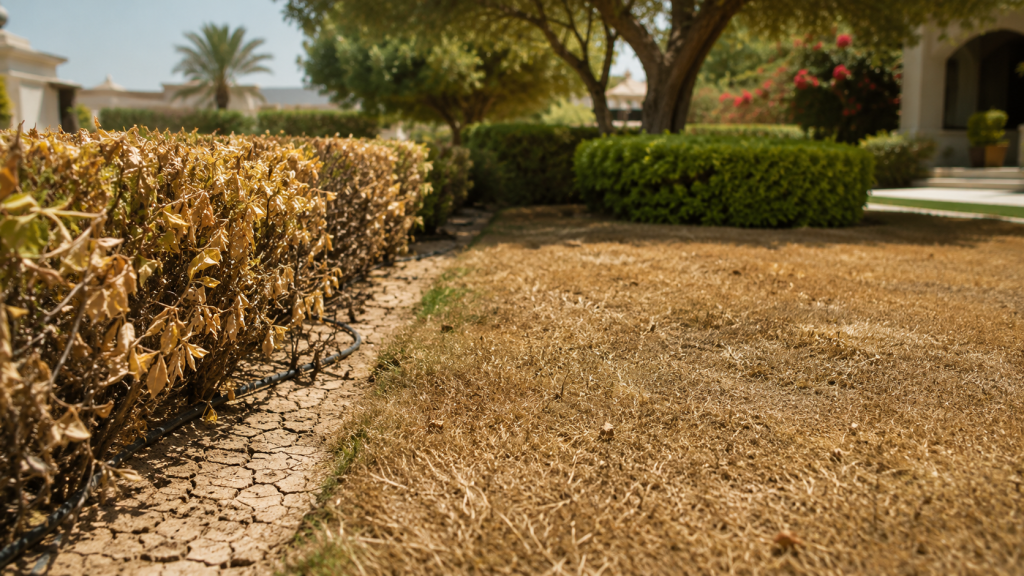
Every year the pattern repeats. Gardens, villa landscaping, and commercial outdoor spaces across Dubai look lush and full through the cooler months, then by July large sections have browned out, wilted, or died completely. By September, what was a thriving outdoor space needs a near total replant.
This is not bad luck, and it is not inevitable. It is the predictable result of landscaping that was designed and maintained for winter conditions, then left on the same plan through summer. The plants that struggle most are not poorly chosen in general, they are poorly matched to what happens to soil, water, and sunlight once temperatures pass 40 degrees Celsius for months at a time.
Here is exactly why outdoor landscaping fails in Dubai summers, and what a properly adjusted system looks like.
The Diagnosis
Why Plants Die in Dubai Heat
Four forces combined to put outdoor landscaping under extreme stress through the UAE summer.
Direct midday sun exposure.
Surface soil temperature in direct Dubai sun can exceed 60 degrees Celsius by early afternoon. Plants positioned without any shade structure or canopy cover absorb far more heat than their root systems can offset, leading to leaf scorch, wilting, and eventually plant death, even in species that are otherwise heat tolerant.
Irrigation evaporation rates.
Evaporation rates in Dubai summer can be three to four times higher than in winter. An irrigation schedule that was correctly calibrated for cooler months delivers nowhere near enough water in July and August, since a large percentage of what is applied evaporates before it reaches the root zone.
Soil salinity from over watering with hard water.
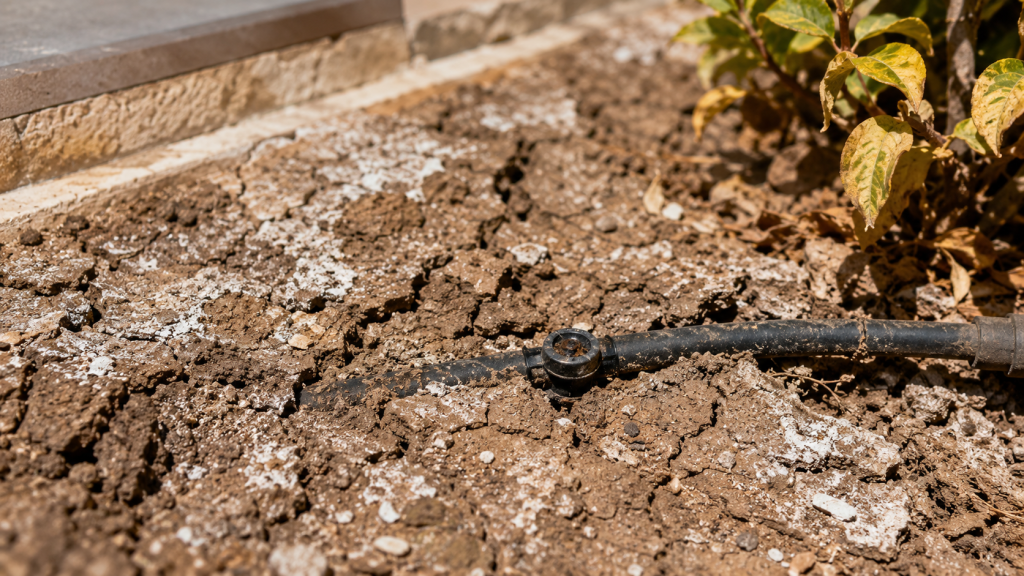
In an attempt to compensate for heat stress, many gardens are simply watered more often using UAE’s naturally hard, mineral heavy water supply. Without proper drainage and periodic flushing, this causes salt to accumulate in the topsoil, which damages root systems and is a major hidden cause of plant decline that looks like heat stress but is actually a soil chemistry problem.
Wrong plant choices for extreme heat.
Many ornamental species that perform well in milder climates, or even in Dubai’s winter, simply cannot survive sustained exposure above 45 degrees Celsius. Without species selected specifically for extreme heat tolerance, a landscaping plan is working against the climate rather than with it.
The Fix
How to Keep Outdoor Landscaping Alive Through a Dubai Summer
A landscape that survives the UAE summer is not one that simply gets watered more. It is one that has been deliberately adjusted across four areas.
Shade structuring and plant placement
Heat sensitive plants should be positioned to benefit from natural or built shade during peak afternoon hours, whether that is the shadow of a building, a pergola, or strategically placed larger trees that create a canopy over more delicate planting beneath them. Shade structuring is one of the most cost-effective interventions available and is often overlooked in original landscaping plans that were designed primarily around winter appearance.
Adjusted irrigation timing and volume
Summer irrigation needs to run earlier, before sunrise, and in some cases again after sunset, to reduce evaporation loss. Volume per cycle should increase to match higher evapotranspiration rates, but this needs to be paired with proper drainage so the additional water does not simply sit and contribute to salinity buildup. A summer irrigation schedule is fundamentally different from a winter one and should be treated as a separate plan, not a scaled-up version of the same settings.
Soil and mulch strategy
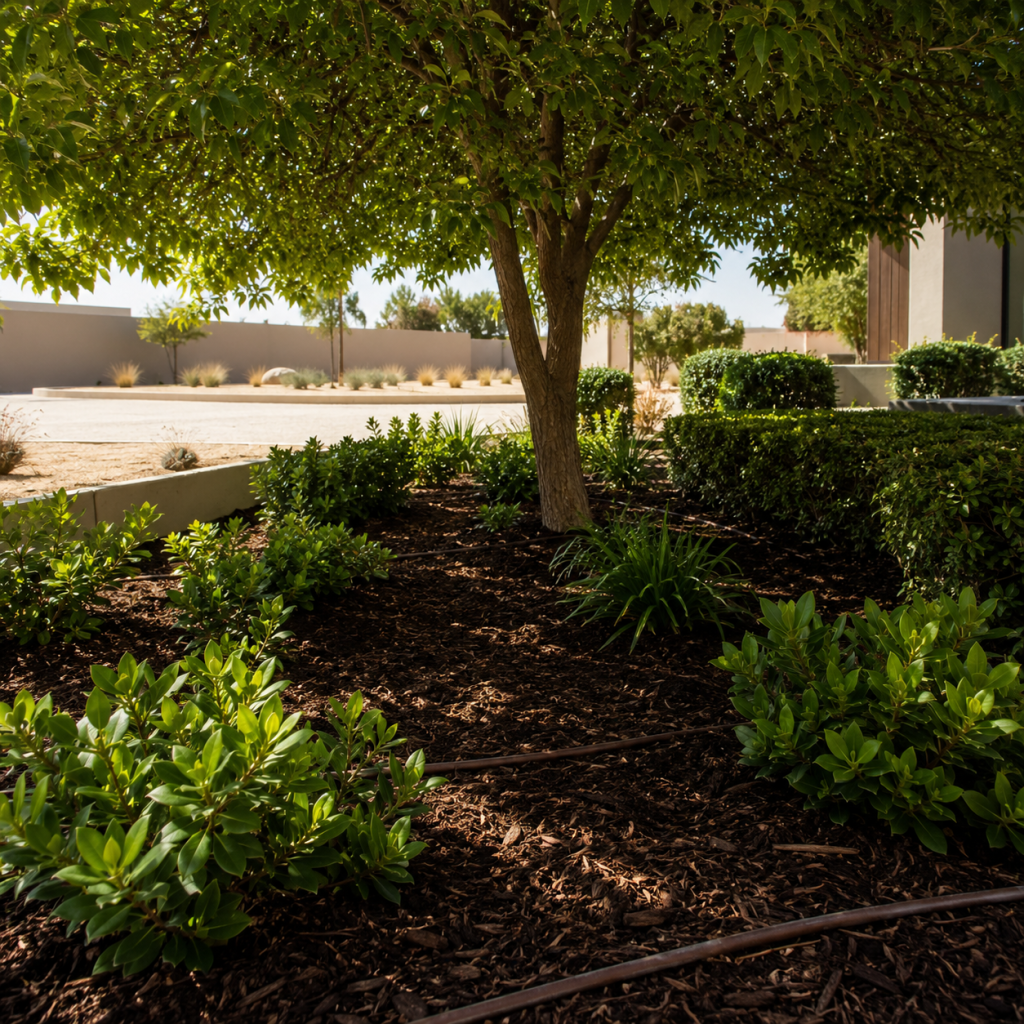
A layer of organic mulch across planting beds significantly reduces surface evaporation, keeps root zone temperatures lower, and slows the rate at which salts concentrate near the surface. Combined with periodic deep watering to flush accumulated salts below the root zone, this is one of the simplest and most effective ways to protect soil health through summer.
Heat tolerant species selection
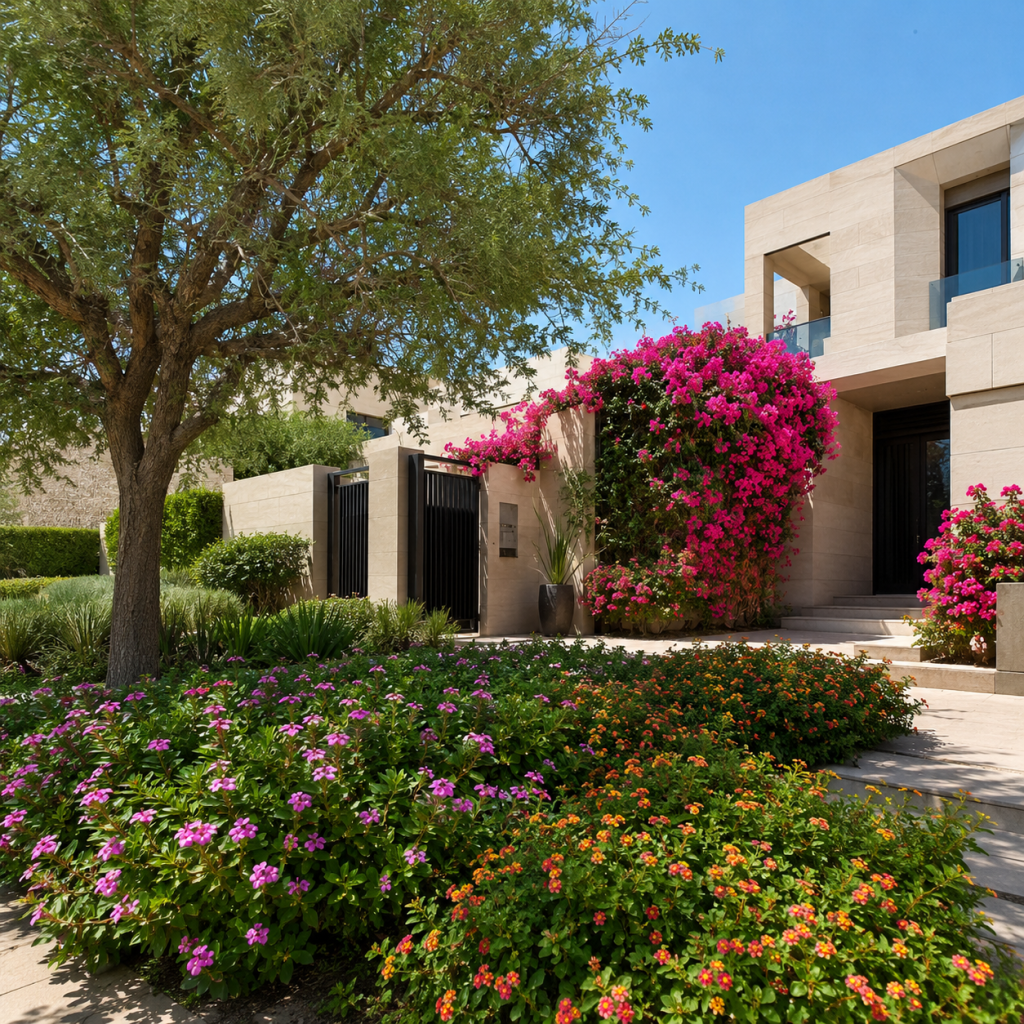
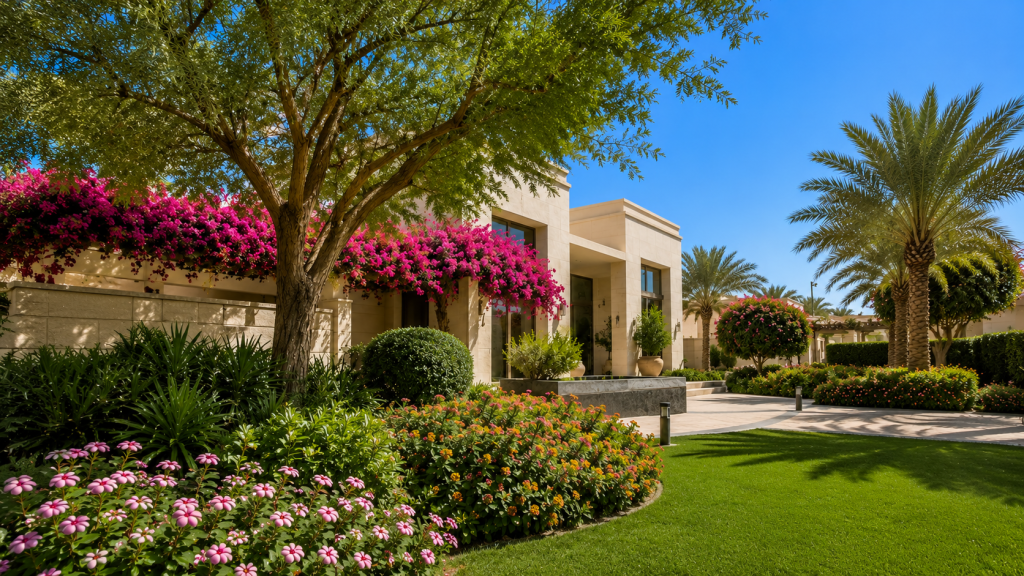
Outdoor landscaping built around species that are naturally suited to extreme heat performs dramatically better with far less intervention. Proven options for UAE outdoor landscaping include ghaf trees, bougainvillea, vinca, lantana, desert rose, and various native and desert adapted succulents. These species are not simply tolerant of heat, many are adapted specifically to the high temperature, low humidity, and high salinity conditions found across the UAE.
The Real Reason Most Plans Fail
Why a Fixed Year-Round Maintenance Plan Does Not Work
The single biggest reason outdoor landscaping fails every summer is that the maintenance plan does not change with the season. A fixed Annual Maintenance Contract that applies the same irrigation frequency, the same pruning schedule, and the same fertilization timing across twelve months is, by definition, wrong for at least half the year.
A properly structured AMC for the UAE climate builds in a seasonal adjustment, with irrigation volume, timing, and frequency recalibrated as temperatures rise, additional soil flushing scheduled specifically to manage salinity buildup, increased monitoring frequency during peak heat months to catch stress early, before visible damage occurs, and pruning and fertilization timed to reduce plant stress rather than add to it during extreme heat.
Outdoor spaces maintained on a seasonally adjusted plan consistently outperform those left on a static schedule, often at a similar overall cost, simply because the resources being used are matched to what the plants actually need at that time of year.
Getting Ahead of Summer Instead of Recovering From It
Most outdoor landscaping damage in Dubai is not caused by one extreme heat event. It builds gradually over weeks of mismatched irrigation, unmanaged sun exposure, and a maintenance plan that never adapted to the season. By the time browning and dieback are visible, the underlying stress has usually been building for some time.
The good news is that this is entirely preventable. With the right combination of shade planning, an adjusted irrigation schedule, proper soil management, and heat tolerant plant selection, outdoor landscaping in the UAE can stay healthy and full right through the hottest months of the year.
The earlier these adjustments are made in the season, the less recovery is needed later.
Ready to get your outdoor space summer ready?
The Plantscapes team provides summer readiness assessments for villas, commercial properties, and hospitality groups across Dubai and the wider UAE. We evaluate irrigation timing, shade coverage, soil condition, and plant selection, then provide a seasonal adjustment plan built around your specific landscape before peak heat sets in.