


Indoor Planting for Healthcare and Wellness Interiors: What Designers Need to Consider in the UAE
Healthcare and wellness interiors are designed around more than appearance. Movement, privacy, cleanability, maintenance and facility protocols all influence what can be introduced into the space. Indoor planting for healthcare interiors therefore needs a different level of consideration from planting in a typical office or hotel lobby.
Plants can bring visual softness, natural texture and a calmer character to reception areas, waiting spaces, staff lounges and appropriate wellness areas. The decision, however, should begin with the function of the space rather than with a preferred plant or planter.
Hospital entrances, specialist clinics, rehabilitation centres, dental practices and wellness facilities may all use planting differently. The most successful schemes respond to those differences rather than applying one standard planting formula across every healthcare environment.
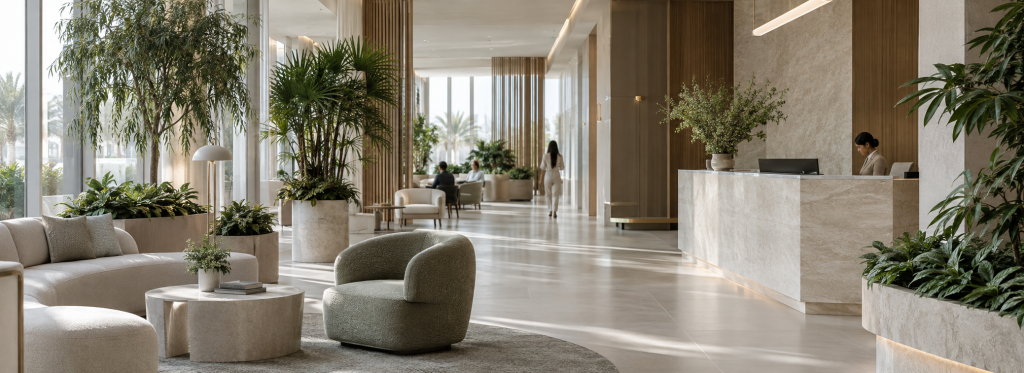
Indoor planting in healthcare is not one category
The term healthcare interior can describe very different environments. A public lobby has different operational needs from a treatment room. A staff breakout space has different requirements from a patient waiting area. A wellness reception may allow a more residential design language than a clinical corridor.
That distinction should shape the planting strategy. Before selecting species, the project team should identify who uses the space, how long people remain there, how frequently the area is cleaned, whether clinical activities take place nearby and how maintenance teams can access the planting without disrupting normal operations.
This is particularly important in healthcare because an attractive location on a drawing may not be the most practical location once circulation, cleaning, access and facility procedures are considered together.
Where indoor planting for healthcare interiors works best
Living plants can work well in many public and staff areas when the environmental conditions and facility policies support them. Entrance lobbies, reception zones, general waiting areas, staff lounges, administrative offices and selected rehabilitation or wellness spaces can all offer suitable opportunities.
These locations allow planting to contribute to the experience of the interior without being placed within areas where treatment takes place. The aim is not to fill every available corner. It is to identify the spaces where plants can become part of the architecture while remaining practical to manage.
Healthcare facilities should still confirm suitability with their infection prevention and operations teams. Guidance from the United States Centers for Disease Control and Prevention notes that potted plants do not need to be restricted from patient care areas for immunocompetent patients. The same guidance states that fresh flowers, dried flowers and potted plants should not be used in patient care areas for immunosuppressed patients. The policy of each facility should always take priority.
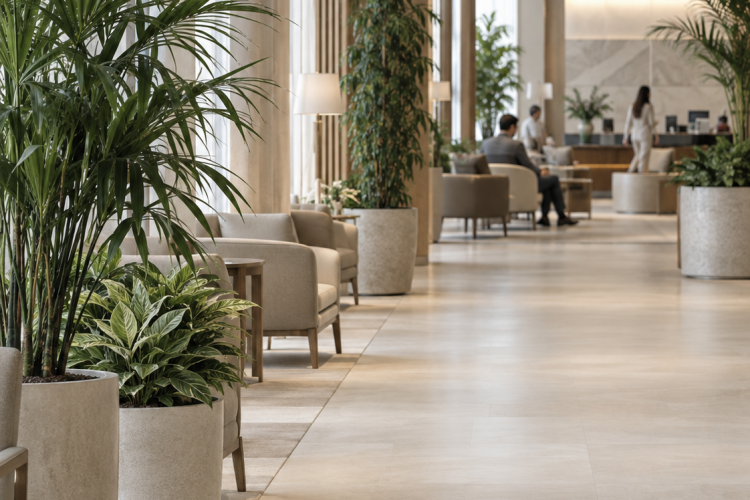
Start with circulation, sightlines and access
In a healthcare interior, planting should never compete with movement through the space. Planters should be positioned so that routes remain clear, reception teams retain good visibility and doors, handrails, service points and other functional elements remain easy to reach.
This often means using planting to define the edge of a waiting area rather than placing it in the middle of a route. It may mean choosing a taller, narrower plant form instead of a wide specimen that projects into circulation. Elsewhere, a low planting composition may preserve sightlines more effectively than a tall screen.
The scale of the plant matters, but so does the mature spread of the canopy. A specimen that fits comfortably on installation day can become intrusive if its natural growth habit has not been considered.
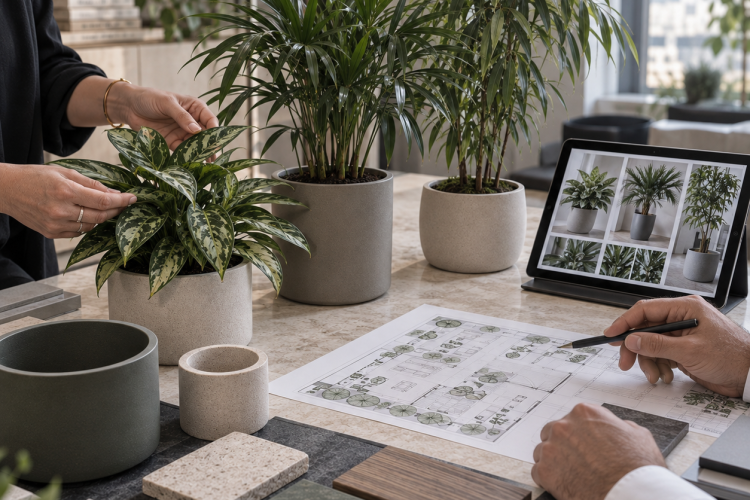
Plant selection should follow the conditions of the space, not simply the design mood. Light levels, glazing, air conditioning, air movement, temperature and the distance from entrances can all change how a plant performs.
A bright reception beside floor to ceiling glazing may support species that would struggle in a deep internal waiting zone. A plant positioned directly below a strong air outlet may respond differently from an identical specimen only a few metres away. Entrances can also experience greater temperature fluctuations than interior areas.
This is why a site assessment is more useful than selecting plants from a generic list. Plantscapes can support plant curation through site surveys, lighting assessments, supply, installation and ongoing care, allowing the selection to respond to the actual environment rather than to appearance alone.
Planters are part of the operational detail
In healthcare and wellness interiors, the planter is not simply a decorative container. Its size, stability, surface finish, liner, access and relationship with the surrounding floor all influence how easy the installation is to live with.
Smooth and durable finishes can make routine cleaning around the planter more straightforward. Stable forms are important in busy public areas. The planter should also be proportionate to the plant and its nursery grow pot, while leaving enough internal space for practical installation and servicing.
Where planters are integrated into joinery or built into architectural elements, access for horticultural maintenance should be resolved before installation. A visually seamless detail is only successful if the plant can still be inspected, watered, pruned or replaced when required.
Where custom planters are part of the project package, the collaboration can be credited as: Custom planters by Desert Pottery | Installed & maintained by Plantscapes.
Cleanability and maintenance need to be designed in
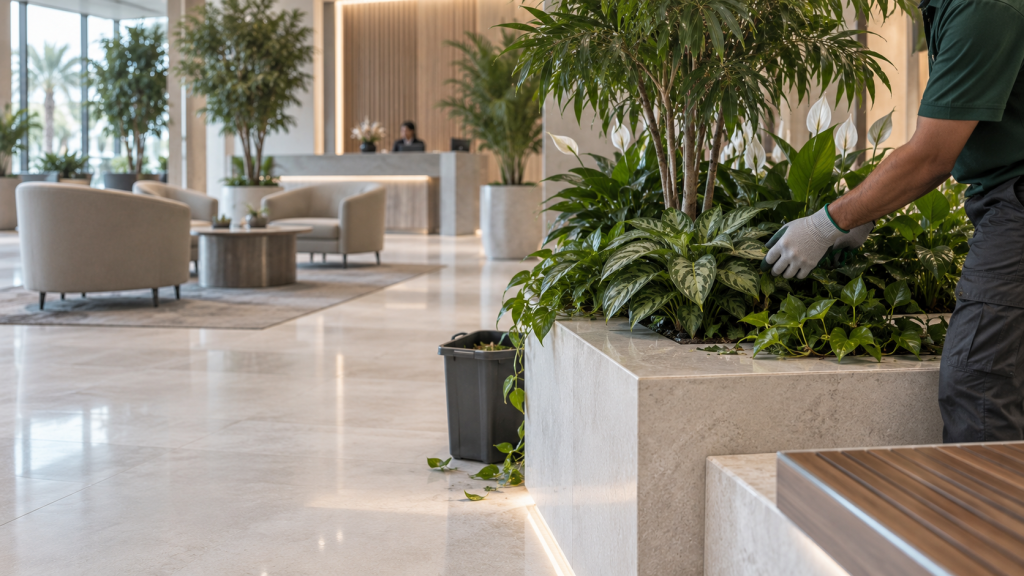
Healthcare interiors follow defined operational routines, so indoor planting should be detailed with those routines in mind. The surrounding floor should remain accessible for cleaning, fallen leaves should be easy to reach and the planting should not make adjacent surfaces difficult to maintain.
The same principle applies to horticultural servicing. Maintenance teams need enough working space to inspect foliage, check growing media, remove debris and carry out plant care without blocking a reception desk or disturbing a busy waiting area.
Maintenance timing also matters. In active facilities, service visits may need to happen during quieter periods or in coordination with facilities management. Planning for that access from the beginning is far better than discovering after handover that a planter cannot be reached without moving furniture or interrupting circulation.
Infection control requirements must guide the specification
Planting decisions in healthcare should never be separated from the facility’s infection prevention strategy. Different areas can carry different requirements, and the design team should confirm those requirements before living plants are specified.
A public reception used by the general population is not the same environment as a protected patient care zone. This is why a blanket approach, whether that means plants everywhere or no plants anywhere, is too simplistic. The correct decision depends on the type of facility, the users of the space and the policies applied by the healthcare operator.
Designers should therefore involve the relevant clinical, infection prevention and facilities teams early enough for the planting strategy to respond. Where living plants are not appropriate, another biophilic element may be more suitable.
When living plants are not the right solution
Biophilic design does not require every natural reference to be a living plant. In some healthcare locations, preserved botanical features, premium artificial planting, natural materials, landscape views or artwork inspired by nature may provide a more appropriate response.
The choice should still be evaluated against cleaning requirements, material performance, fire performance and operational needs. Preserved moss, for example, can work well in dry internal locations but should not be placed where it will be exposed to water, direct sunlight or repeated physical contact.
The important point is that the design intent can remain connected to nature even when a living plant solution is not suitable for a particular zone.
Maintenance should be part of the healthcare planting strategy
Healthy indoor planting depends on consistent care after installation. Watering, pruning, cleaning foliage, monitoring plant condition and replacing individual specimens when necessary all contribute to the appearance of the scheme over time.
For healthcare facilities, that maintenance should be coordinated with the building’s operations. Service teams need clear access, agreed visit times and an understanding of any protocols specific to the facility that affect how work is carried out.
The supply side also matters. For projects that require coordinated quantities or replacement stock, Wahat Al Sahraa Nursery can support the broader plant selection and supply process with access to different species and sizes.
A more considered approach to healthcare and wellness interiors
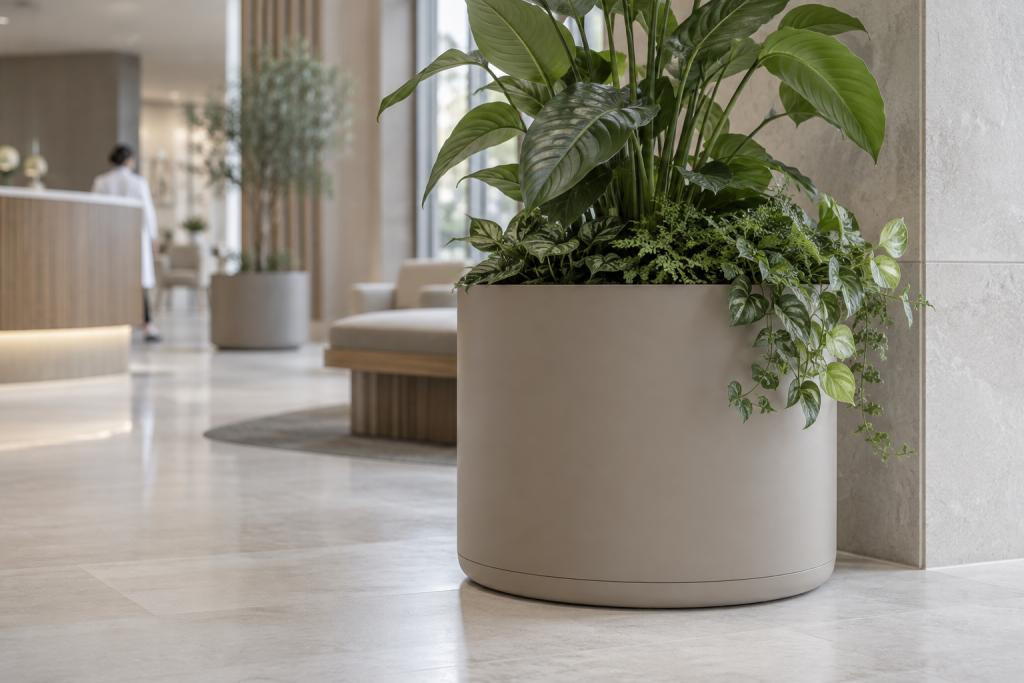
The strongest planting schemes in healthcare and wellness interiors are rarely the ones with the greatest number of plants. They are the ones in which planting has been positioned carefully, selected for the actual environment and integrated with the operational needs of the facility.
Indoor planting for healthcare interiors works best when designers consider circulation, infection control, cleanability, maintenance and horticultural conditions as interconnected parts of one coordinated decision. That approach protects the design intent while making the finished space easier to operate and care for.
For Plantscapes, the role of planting in healthcare is not to make a clinical environment look like a garden. It is to introduce nature with restraint, sound horticultural knowledge and a clear understanding of how the space needs to function.
A Better Specification Creates a Better Finished Space
For advice on a specific indoor planting project, Plantscapes can support plant selection, specification, supply, installation and ongoing care across commercial and hospitality interiors in the UAE.
Click Here