


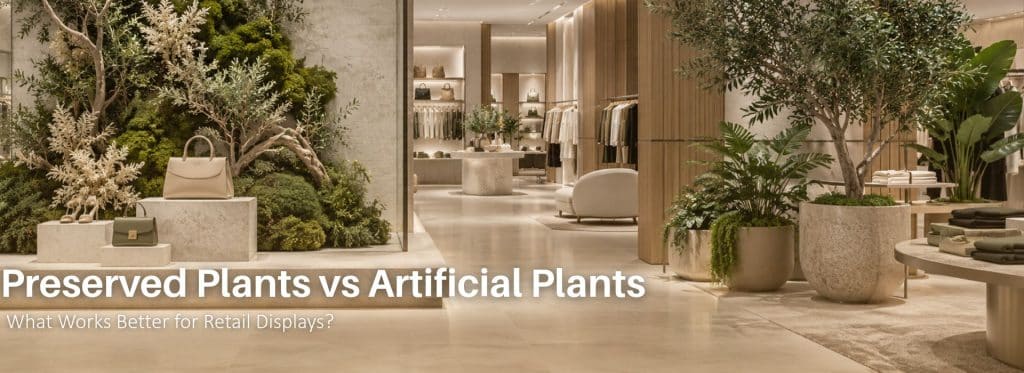
Retail planting has to do more than look good on opening day. It needs to support the brand, work with changing displays and remain presentable under lighting, customer movement and regular cleaning.
For designers choosing artificial and preserved plants for retail, the difference is not simply about which option looks more realistic. Preserved material offers the texture and variation of something that was once living, while artificial planting offers greater flexibility in shape, placement and repeated handling. The right choice depends on where the planting will sit and how the display is expected to perform.
What is the difference?
Preserved plants are real plants or trees that have been treated so their natural appearance can be retained without regular watering or routine plant care. Because the material began as living foliage, it can offer subtle variation in texture, branching and form.
Artificial plants are manufactured to recreate the appearance of natural planting. High quality options can be designed around specific heights, canopy widths, densities and trunk forms, giving retail designers more control over scale and composition.
When preserved plants work well in retail
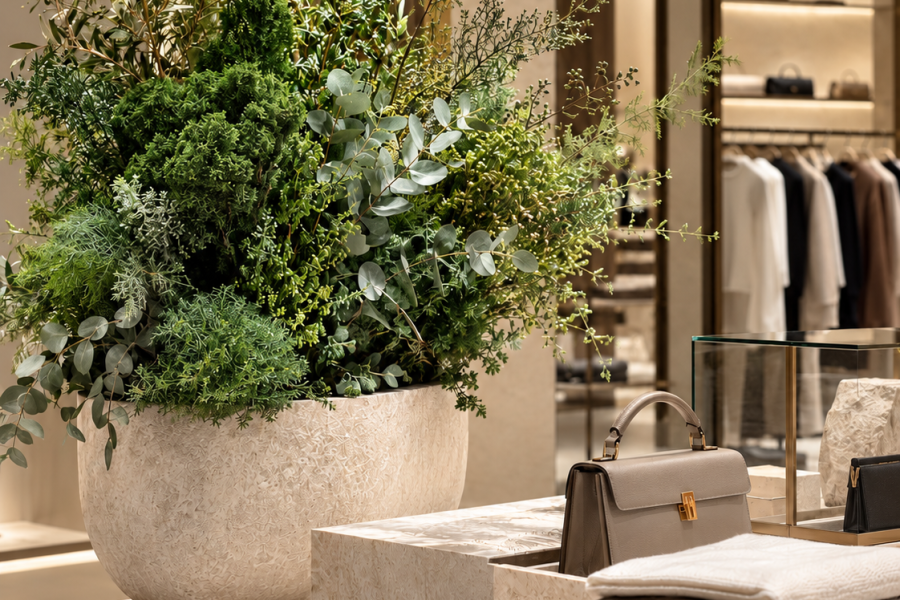
Preserved planting is strongest where the design depends on natural texture and close viewing. Boutique interiors, premium fitting areas, quiet product lounges and feature displays can benefit from material that feels softer and less uniform than conventional faux foliage.
It is best used in controlled interior areas where the foliage is protected from water, strong direct sunlight and frequent physical contact. In these locations, preserved material can offer a natural botanical character without the maintenance requirements of live plants.
When artificial plants are the stronger choice
Artificial planting is more adaptable in areas that experience repeated merchandising changes or higher levels of customer interaction. Window displays, store entrances, promotional zones and product tables may need planting that can be moved, reshaped or reused as campaigns change.
Plantscapes offers artificial plants and trees with UV and fire protection ratings, along with bespoke options where density, height and canopy width can be selected for the project. This gives designers more control where durability and consistency are priorities.
Artificial and preserved plants for retail lighting conditions
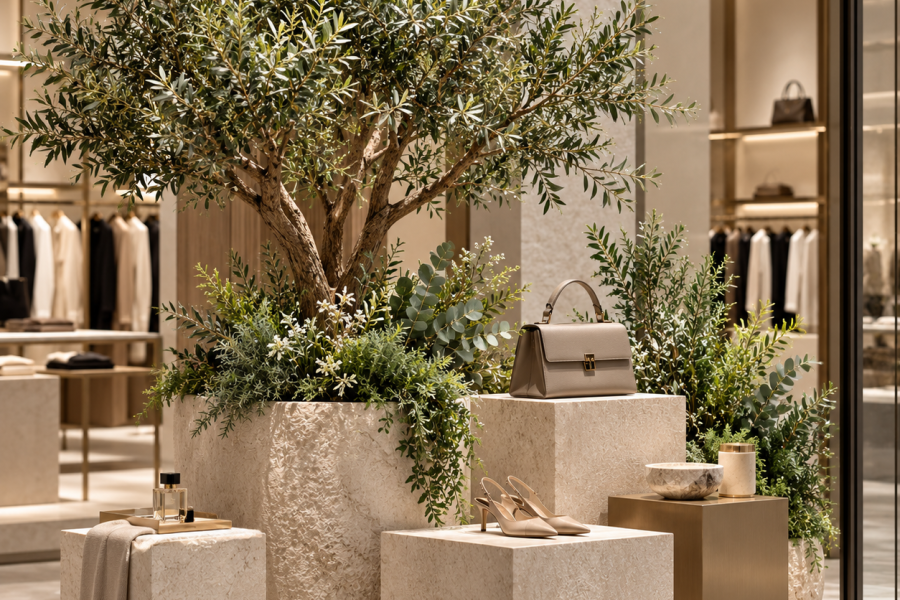
Lighting can change how both materials are perceived. Strong spotlights can reveal overly glossy artificial leaves, while soft directional lighting can make well detailed faux planting appear more natural. Preserved foliage generally benefits from gentler lighting that highlights texture without unnecessary heat or direct sun.
Samples should therefore be reviewed under the actual retail lighting scheme. A material that looks convincing in a showroom can read very differently beside mirrors, glazing or high intensity display lighting.
Think about touchpoints and cleaning
When comparing artificial and preserved plants for retail, customer contact is one of the clearest practical differences. Planting beside a checkout, entrance or narrow aisle may be brushed against many times each day. In these areas, a durable artificial option is usually more practical.
Preserved foliage is better suited to protected locations where it can be appreciated without constant handling. Cleaning also needs to be gentler, while artificial foliage can usually tolerate careful dusting more easily. Placement should therefore reflect the store cleaning routine as well as the visual concept.
How often will the display change?
A permanent boutique interior and a campaign-led retail environment have different needs. If the planting is intended to remain in one carefully composed location, preserved material can provide a refined and natural character.
If visual merchandising changes several times each year, artificial plants may offer more flexibility. They can be repositioned, regrouped and combined with seasonal elements without relying on the conditions required by living or preserved material.
Planters still matter
The planter can determine whether either option feels integrated or temporary. A high-quality artificial tree in an undersized container can look less convincing, while preserved planting can lose its premium character if the planter finish does not relate to the store interior.
Plantscapes supplies planters in a range of materials, sizes and finishes, including bespoke options. Matching the planter to joinery, flooring and display fixtures helps the planting read as part of the retail design rather than an added accessory.
A practical comparison
Choose preserved planting when natural texture, close viewing and a controlled indoor location are the priorities. Choose artificial planting when durability, repeated handling, difficult light conditions or frequent merchandising changes matter more.
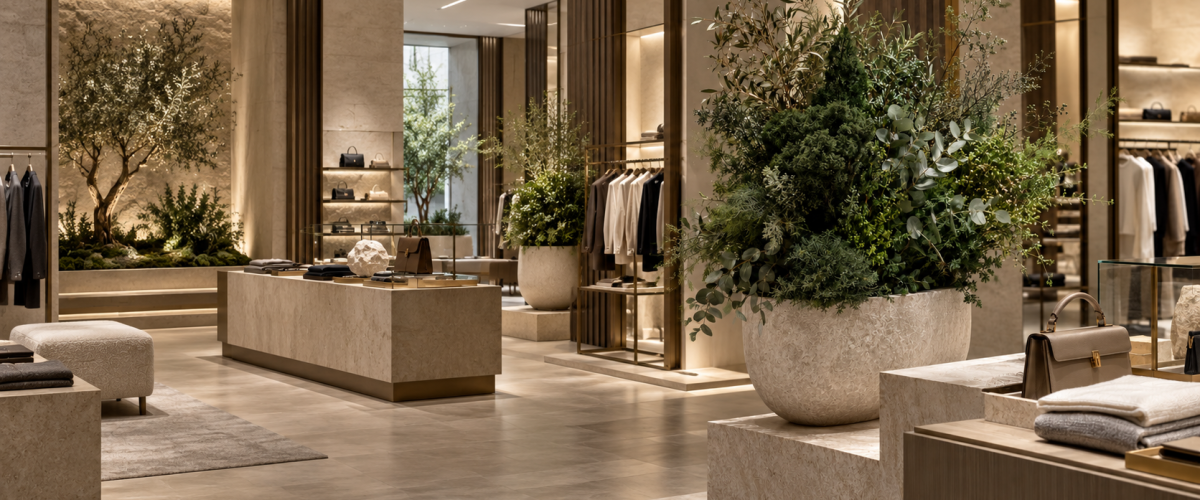
For many retail projects, the best answer is a combination. Preserved material can be reserved for protected feature moments, while artificial plants handle entrances, window displays and flexible campaign zones.
Choose according to the display, not the label
There is no universal winner between the two materials. Artificial and preserved plants for retail should be selected according to lighting, viewing distance, customer contact, cleaning routines, display frequency and the visual language of the brand.
Plantscapes works with designers and commercial teams to review artificial and preserved planting options, prepare samples and coordinate supply and installation. The objective is not to make every retail zone use the same material, but to choose the option that will continue to look appropriate once the store is operating.